
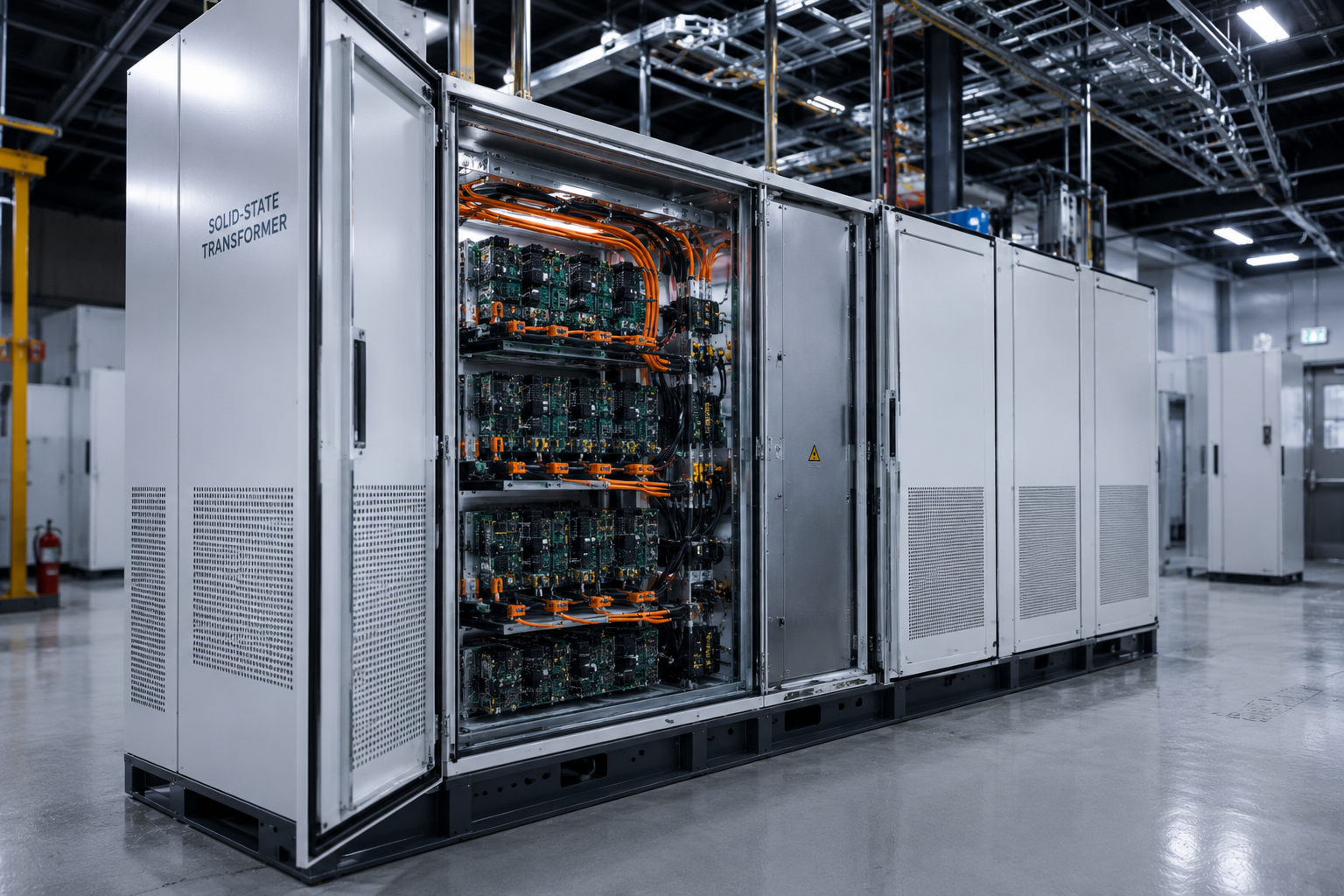
A decades-old piece of gray iron is being reinvented in silicon carbide, and the winners could reshape how AI campuses get built.
By Debra Brewster | Partner / CEO, Axiom AI Group USA, LLC
For more than a century, the transformer sitting behind a data center has been one of the least glamorous pieces of equipment in the building: a steel box full of copper windings and oil, doing the same job it did in the 1920s. That is changing fast. Solid-state transformers, or SSTs, use silicon carbide and gallium nitride semiconductors instead of copper coils to convert power, and the data center industry is betting heavily that they are the missing piece needed to keep pace with AI’s runaway appetite for electricity.
The appeal is straightforward. Traditional transformers are large, heavy, slow to manufacture, and increasingly hard to get, with lead times for high-voltage units now stretching past three years. Solid-state alternatives can shrink the electrical footprint of a facility by an estimated 70 to 80 percent, cutting out layers of switchgear and distribution equipment a conventional power chain requires.
Several vendors are already advertising peak efficiencies above 98 percent, converting medium-voltage utility power directly into the 800-volt direct current architecture that Nvidia and its hardware partners are pushing as the standard for next-generation AI racks.
That 800V DC push is really what is driving the urgency. As GPU racks move from roughly 120 kilowatts today toward a projected one megawatt per rack later this decade, the copper busbars needed to move that much current under the old 54-volt architecture become physically absurd, with some estimates suggesting a single gigawatt-scale campus could require hundreds of thousands of tons of copper under legacy designs. Solid-state transformers, paired with high-voltage direct current distribution, promise to cut the conductor and conversion losses out of that equation entirely.
The money has followed the technology. Heron Power closed a $140 million funding round earlier this year backed by Andreessen Horowitz’s American Dynamism Fund and Breakthrough Energy Ventures. DG Matrix raised $60 million with backing from Mitsubishi Heavy Industries and ABB. Established players are moving too: Eaton acquired Austin-based Resilient Power Systems to bring solid-state technology in-house, while Hitachi Energy has committed roughly a billion dollars toward US manufacturing capacity, including a new transformer factory in South Boston, Virginia. Delta Electronics has already deployed its own solid-state system at a hyperscale campus in China, converting medium-voltage power directly into 240V, 400V, and 800V DC outputs.
Even Enphase Energy, better known for residential solar equipment, has entered the race with a distributed 1.25-megawatt “supercluster” built from hundreds of hot-swappable power modules, targeting customer pilots next year and volume shipments by 2028. Analysts at Goldman Sachs have pegged the addressable market for solid-state transformers at roughly 10 gigawatts by 2030, worth as much as $5 billion in revenue across the industry.
It would be a mistake, though, to describe this as a mature market ready for wide deployment tomorrow. Most integrator-level products remain in pilot or early commercial stages, with volume shipments generally targeted for 2027 and 2028. The underlying semiconductor components, silicon carbide MOSFETs and related switching hardware, are comparatively battle-tested from years of use in electric vehicles and industrial power systems. What is new is packaging that technology into a certifiable, utility-grade transformer that can survive decades of continuous duty at a hyperscale campus.
For developers evaluating sites today, the practical takeaway is this: solid-state transformers are not yet a drop-in replacement for the conventional equipment sitting in a three-to-five-year backlog, but they represent a credible medium-term escape route from that bottleneck. Any project with a construction timeline stretching into 2027 and beyond should be tracking this space closely, because the vendor who solves certification and manufacturing scale first may hold real leverage over which campuses get built on schedule and which do not.