
From Cold Aisles to Cold Plates: Liquid Cooling Becomes the Default for AI Infrastructure
As rack densities blow past 30 kilowatts, air conditioning is running out of road, and the industry is settling on a dual-track liquid future.
By Debra Brewster | Partner / CEO, Axiom AI Group USA, LLC
Five years ago, liquid cooling in data centers was a niche technology found mostly in supercomputing labs. Today it is closing in on 40 percent penetration across new builds, and among facilities purpose-built for AI workloads it is rapidly becoming the default rather than the exception. The reason is simple physics: air can no longer carry heat away fast enough to keep up with the chips being installed.
Average rack density has climbed from around 15 kilowatts just a couple of years ago to roughly 27 kilowatts today, driven largely by Nvidia’s Blackwell-generation chips, and the trajectory only steepens from here. Nvidia’s forthcoming Rubin Ultra rack architecture is expected to approach 600 kilowatts in a single rack by 2027. At that density, the conversation stops being about which cooling technology is more efficient and becomes about which one is physically capable of keeping the equipment from throttling itself into uselessness.
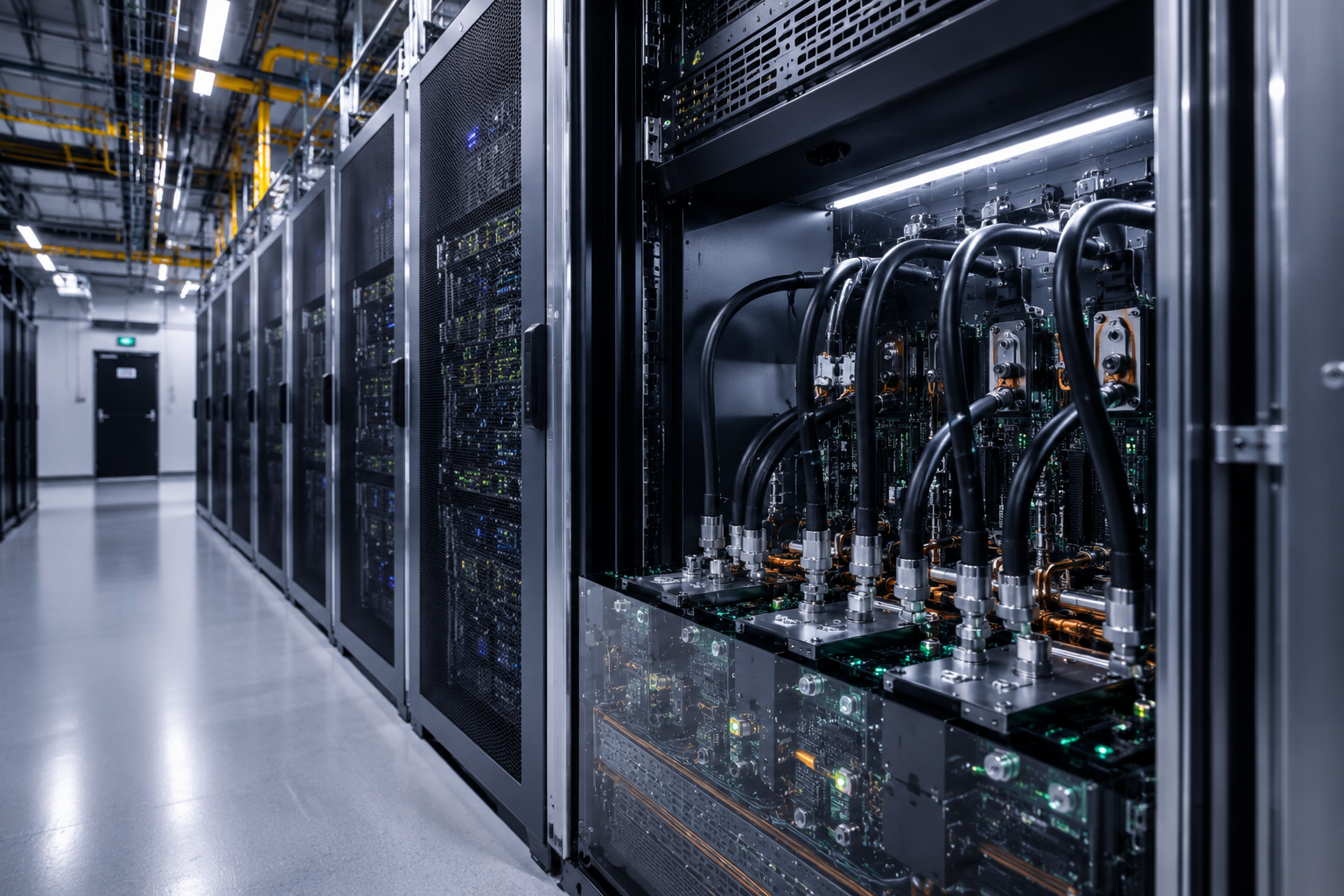
Two approaches are emerging as the industry standard, and for now they are not competing so much as dividing the market by use case. Direct-to-chip cooling, which circulates coolant through cold plates mounted directly on processors, has become the fastest-growing method because it can be retrofitted into fairly conventional rack and room designs while still handling the thermal loads of today’s most powerful GPUs. Immersion cooling, which submerges entire servers in a dielectric fluid, delivers even better results, with single-phase immersion systems achieving a power usage effectiveness of roughly
1.03 to 1.08, compared with 1.50 to 1.80 for traditional air-cooled facilities, but it demands a more fundamental redesign of how a data hall is built and operated.
The economics increasingly favor making the switch sooner rather than later. Immersion systems can cut cooling energy consumption by 30 to 40 percent and water use by as much as 90 percent compared with air-cooled baselines, according to several industry analyses, and the payback period on the added upfront cost is now running under two years for facilities carrying rack loads above 45 kilowatts. Dell, HPE, and Lenovo have all begun shipping factory-validated, immersion-ready servers, reducing the validation burden that once made immersion feel experimental.
None of this is happening in a vacuum from the power conversation. Every megawatt spent moving heat is a megawatt not available for compute, at a moment when power itself is the binding constraint on how fast new AI capacity can come online. That has pushed cooling from a back-office facilities
decision into a strategic one, discussed at the same table as power procurement and site selection. Some operators are even exploring cooling systems that use artificial intelligence to predict thermal loads in real time and adjust coolant flow before a hotspot forms, squeezing out additional efficiency gains that a fixed-setpoint system simply cannot match.
The likely outcome over the next few years is not a single winning technology but a stratified market: direct-to-chip cooling handling the bulk of mainstream enterprise and hyperscale AI deployments, and immersion cooling reserved for the most extreme density environments where nothing else will do the job. What is no longer in question is whether liquid cooling becomes standard practice in serious AI infrastructure. That transition is already well underway, and facilities still betting on air alone are increasingly building themselves into a ceiling they will hit within a few years.