
Not a Power Plant, But Acts Like One: Why Hyperscalers Are Betting on VPPs
Google, Tesla, and Sunrun are aggregating home batteries and thermostats into gigawatt-scale capacity, aimed squarely at data center demand.
By Debra Brewster | Partner / CEO, Axiom AI Group USA, LLC
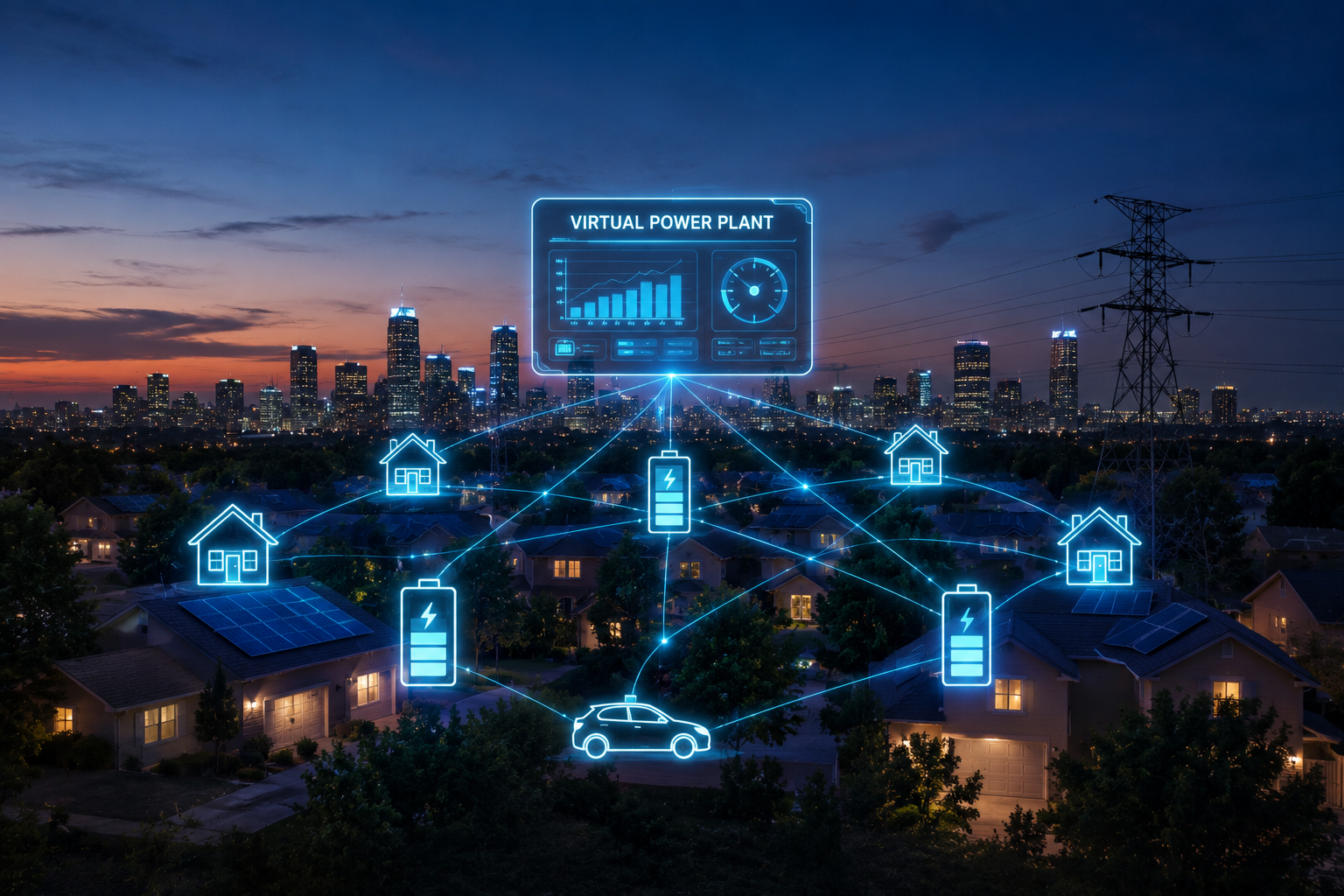
When Google signed a deal this year with demand-response provider Voltus, it marked something the industry had not seen before: a hyperscaler directly funding a virtual power plant to help clear the way for its own data centers. Under the arrangement, Voltus will assemble up to 100 megawatts of capacity from home batteries, electric vehicles, and smart thermostats across the PJM Interconnection, the grid serving 67 million people across the eastern United States. Google pays for the setup; participating homeowners get paid to shift or reduce their usage during periods of peak grid stress.
A virtual power plant, or VPP, is not a facility in the traditional sense. It is a coordinated network of small, distributed energy resources that a software platform can dispatch collectively, functioning from the grid’s perspective like a conventional power plant without ever building one. The concept has existed for years, but data center demand is turning it from a niche grid-reliability tool into a mainstream procurement strategy. The US Department of Energy estimates roughly 30 gigawatts of VPP capacity is deployed today, with the potential to reach 160 gigawatts by 2030, enough to cover about a fifth of national peak demand.
The timing is no coincidence. US data center power demand is projected to climb from roughly 41 gigawatts this year to 66 gigawatts in 2027, even as interconnection queues in the hottest markets stretch four to seven years. Tesla, Sunrun, and Renew Home announced their own answer in June: a 16-gigawatt virtual power plant aggregating home batteries and thermostats, with an initial 300 megawatts already available in Virginia’s “Data Center Alley” and a goal of at least 500 megawatts there by 2030. Sunrun’s chief executive put it bluntly, arguing that “the grid of the 1800s cannot power the innovation” of today.
It is worth being precise about what a VPP actually does for a data center, because the mechanism is widely misunderstood. It does not inject electricity directly into a server hall. Instead, it offsets demand elsewhere on the grid during the narrow windows when the system is most strained, freeing up headroom that a utility can then allocate to a large new customer. Industry analysts at RMI describe several emerging commercial models, including one in which a data center effectively sponsors a utility-run VPP in exchange for expedited interconnection, an evolution of the traditional green tariff arrangement utilities have offered for renewable power.
There is a genuine economic case behind the pitch, not just a public-relations one. An analysis cited by Sunrun and Tesla found that better use of existing grid infrastructure could reduce US electricity bills by $110 billion to $170 billion over the next decade, because the grid today is built to handle rare peak-demand hours rather than typical usage. Shaving those peaks with distributed batteries, rather than building new transmission and generation to cover a handful of hours a year, is the logic underpinning the entire model.
None of this eliminates the harder infrastructure problems facing data center developers, and no VPP by itself has powered a hyperscale campus. But as a tool for buying time, easing community friction over grid strain, and demonstrating good faith with regulators and ratepayers, virtual power plants have moved from an interesting idea to a standard line item in how the largest AI infrastructure players are structuring their power strategy for the second half of this decade.