The Next 30 Months: What to Watch in Data Centers Through 2028
Tighter capital, constrained power, and a widening gap between announced megawatts and megawatts actually delivered define the road ahead.
By Debra Brewster | Partner / CEO, Axiom AI Group USA, LLC
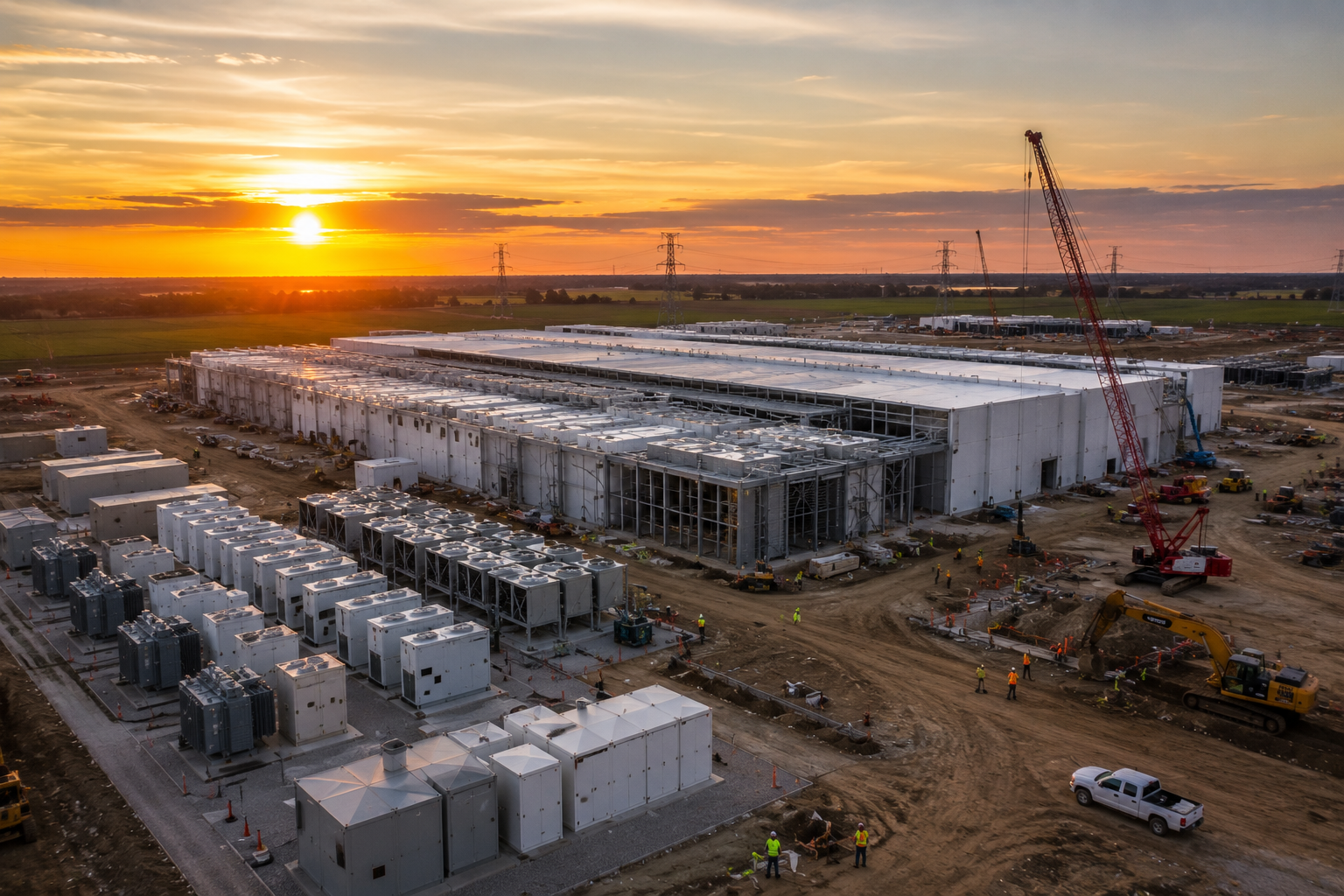
If the last two years of data center development were defined by breathless announcements, the next thirty months will be defined by whether those announcements survive contact with physical reality. Industry leaders are increasingly candid that 2026 looks a great deal like 2025: enormous capital commitments, genuine enterprise AI adoption happening in fits and starts, and a growing gap between the gigawatts that get announced and the gigawatts that actually reach commercial operation.
Power remains the central constraint, and it will remain so through 2028. The industry leased more than 15 gigawatts of new capacity last year, and almost none of it came online in that same period; nearly all of it is scheduled to arrive in late 2026 and 2027, which means a genuine surge in electricity demand is still working its way toward the grid rather than having already hit it. The US Department of Energy’s own modeling suggests data centers could consume somewhere between 9 and 17 percent of national electricity by 2030, up from roughly 4 percent in 2023, a range wide enough to reflect real uncertainty about how much of the announced pipeline actually gets built.
Expect the geography of the industry to keep shifting away from historically dominant markets. Northern Virginia, Phoenix, and Dallas are now reporting grid interconnection waits of four to seven years even for campuses with capital, chip allocations, and shovels already in the ground, which is pushing developers toward secondary and tertiary markets in states with more available generation headroom, even where fiber connectivity and existing infrastructure are less mature. States such as Missouri, Kansas, Nebraska, Indiana, and the Dakotas are increasingly discussed as attractive targets specifically because they combine cleaner renewable portfolio standards with less-constrained water and grid capacity.
On the technology side, three trends are converging simultaneously: the shift toward 800-volt direct current power architectures to handle megawatt-scale AI racks, the near-total transition to liquid cooling for any serious AI workload, and the mainstreaming of behind-the-meter power generation as a first-choice strategy rather than a last resort. Roughly a third of new US data center capacity announced last year was designed to generate at least some of its own power on-site, a figure that was effectively zero just two years earlier.
Financing structures are also evolving quickly. Private equity accounted for the large majority of US data center transactions last year, and increasingly sophisticated vehicles, including industrial revenue bonds, private-credit special purpose vehicles, and long-duration power purchase agreements, are becoming the default way large campuses get capitalized. Expect community benefit agreements, water stewardship commitments, and public reporting dashboards to become standard components of any major project’s approval package, not optional extras, as more than seventy data center projects were rejected or restricted by local governments in just the first four months of this year alone.
The honest read heading into 2028 is one of bifurcation. Developers who locked in power purchase agreements, transformer orders, and interconnection positions years ago are positioned to capture enormous value as AI demand keeps climbing. Developers still working through the interconnection queue with an undefined power strategy face a real risk of project delay, cancellation, or being priced out entirely by more capital-ready competitors. The winners in this next stretch will not necessarily be the companies with the biggest announcements. They will be the ones who solved for megawatts, not just for square footage.