
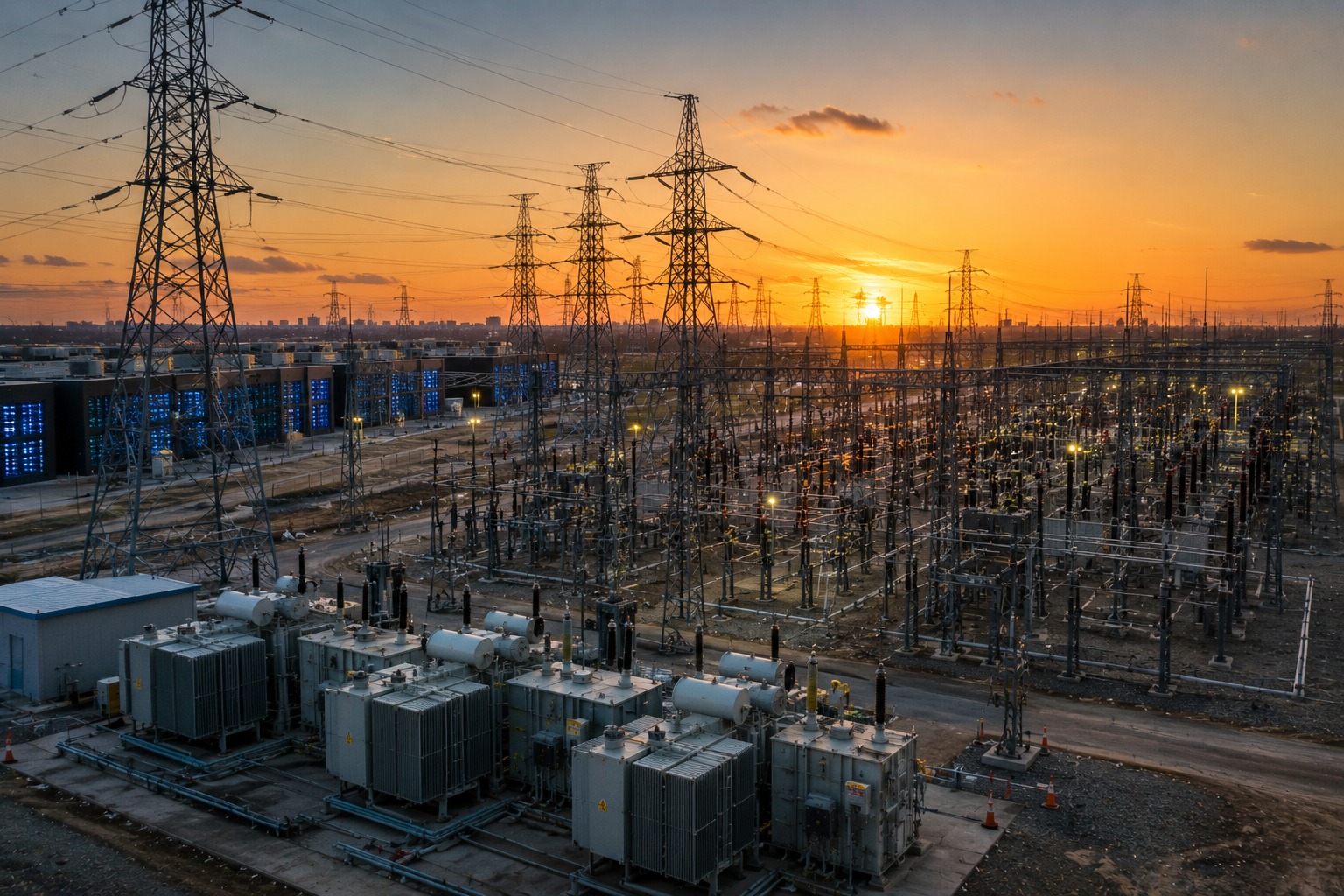
Chips are no longer the bottleneck. The grid is — and the numbers behind that shift are staggering.
By Debra Brewster | Partner / CEO, Axiom AI Group USA, LLC
For the first two years of the generative AI boom, the industry’s anxiety centered on graphics processors: who could get enough of them, and how fast. That anxiety has not gone away, but it has been overtaken by a more fundamental constraint. As of early this year, US grid interconnection queues held roughly 2,600 gigawatts of proposed generation and storage capacity, more than double the entire operating capacity of the existing American power fleet, and the median wait time for a project to reach commercial operation is approaching five years.
For data centers specifically, the picture is worse. Grid interconnection waits in Northern Virginia, Phoenix, and Dallas, the three markets hosting the largest share of announced 2026 capacity, are now running four to seven years, according to data tracked by Sightline Climate and reported by Bloomberg. Google has publicly disclosed transmission connection delays running as long as twelve years in some cases. Of roughly twelve gigawatts of US data center capacity slated to come online this year, only about a third is actually under active construction; the rest sits stalled behind a combination of grid bottlenecks, electrical equipment shortages, and rising local opposition.
The equipment shortage is its own crisis layered on top of the interconnection queue. High-voltage transformer lead times have stretched from roughly two years before 2020 to three to five years today, with switchgear effectively sold out through 2028. The National Electrical Manufacturers Association and multiple industry analysts point to the same root causes: constrained supplies of grain-oriented electrical steel, a shortage of the specialized labor needed to wind and test large transformers, and heavy reliance on Chinese-manufactured components exposed to tariffs and trade friction.
The strain is already visible in wholesale power markets. PJM Interconnection, the regional grid operator serving 65 million people across thirteen states, failed for the first time in its history to procure enough capacity to meet reliability targets in its most recent auction, falling more than six and a half gigawatts short of its target reserve margin. Capacity prices in that market have risen roughly ninefold, and residential electricity bills in the region are projected to climb by fifteen to twenty dollars a month as a direct result, according to Pew’s analysis of market filings.
Federal regulators are responding, though not fast enough to satisfy anyone. The Federal Energy Regulatory Commission ordered six major regional grid operators this year to overhaul how they connect large new electricity customers, explicitly aiming to speed data center interconnection without shifting the resulting infrastructure costs onto ordinary ratepayers. States including Virginia, Georgia,
Indiana, and Washington have already enacted or proposed legislation requiring data center operators to fund infrastructure upgrades in proportion to the electricity they consume, rather than socializing those costs across the broader customer base.
The practical result is a market bifurcating in real time. Developers who secured power purchase agreements, transformer orders, or generation partnerships years in advance are moving forward largely unimpeded. Everyone else is discovering that capital and chip allocations mean very little without a credible, contracted path to electrons. That is the central fact of the data center power crisis: this is no longer a supply chain problem that resolves itself with more capital. It is a physical infrastructure problem that resolves itself only with more transformers, more transmission lines, and more generation, all of which take years to build regardless of how much money is thrown at the timeline.