
Hydrogen’s Second Act: Fueling the GPU Rack Directly
Decades of false starts have given way to real, grid-free deployments running AI hardware entirely on hydrogen fuel cells.
By Debra Brewster | Partner / CEO, Axiom AI Group USA, LLC
Hydrogen fuel cells have been the perennial almost-technology of clean energy for close to fifty years, always promising and rarely delivering at commercial scale. That reputation is being tested directly by the data center industry, where a handful of operators are now running live AI hardware entirely on hydrogen, with no connection to the electric grid at all.
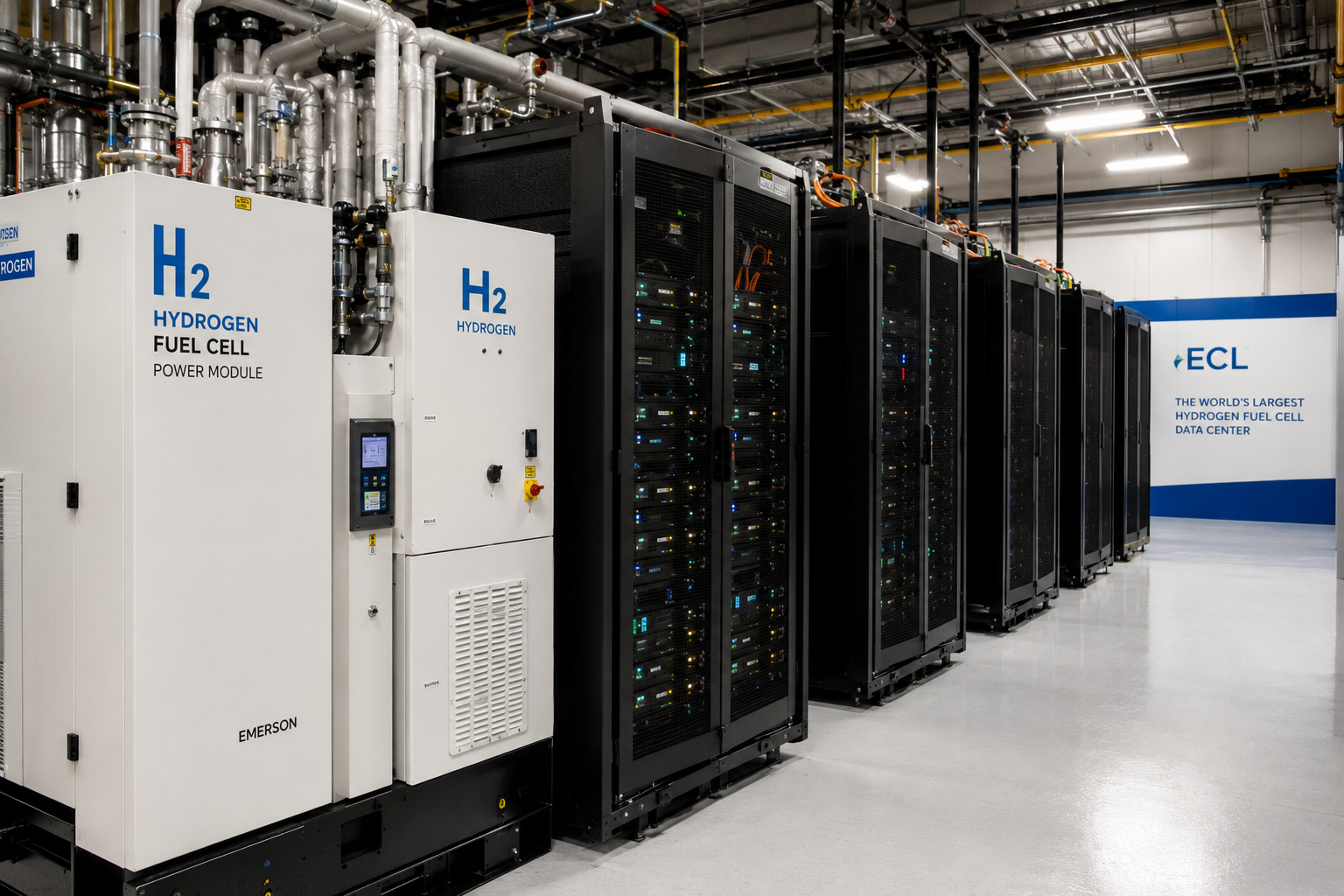
The clearest example is a company called ECL, whose Mountain View, California facility runs a full megawatt of GPU capacity, 1,800 Nvidia GPUs across twenty-two racks, using proton exchange membrane fuel cells as its primary power source, backed by battery storage and a secondary hydrogen fuel cell for redundancy. The facility reports a power usage effectiveness of 1.1, among the most efficient ratings in the industry, and produces water as a useful byproduct that gets recycled into its cooling system. ECL’s founder claims the design can be delivered in under twelve months, versus the typical two-to-three-year timeline for a conventional grid-connected build, at roughly 30 to 40 percent lower cost.
Larger players are testing the same waters more cautiously. Microsoft has run a 48-hour hydrogen fuel cell backup test at a facility in Cheyenne, Wyoming, building on earlier pilots with a 3-megawatt system developed alongside Plug Power and a 1.5-megawatt demonstration with Ballard Power Systems and Caterpillar. In Japan, Honda partnered with Tokuyama Corporation and Mitsubishi Corporation to power a Mitsubishi-operated data center using hydrogen produced as a byproduct of an industrial saltwater electrolysis process, a genuinely elegant example of using waste hydrogen rather than manufacturing it from scratch.
The economics depend heavily on which color of hydrogen is actually available. Green hydrogen, produced through electrolysis powered by renewable energy, remains scarce and expensive. Most early commercial deployments rely on blue hydrogen, produced from natural gas with carbon capture, as a transitional fuel, with operators like ECL explicitly planning to shift the blend toward green hydrogen as supply matures over the coming years. Even so, ECL reports that hydrogen delivered to its site currently costs roughly half what an equivalent amount of diesel fuel would, making the economics workable even before accounting for emissions benefits.
The most likely near-term role for hydrogen is not as the primary power source for gigawatt-scale AI campuses, where fuel storage volume and delivery logistics become genuinely difficult at that scale, but as a serious option for smaller, modular deployments and as a cleaner backup power alternative to diesel generators, which face increasingly difficult air-quality permitting in many states. Vertiv and Ballard Power Systems announced a strategic partnership this year focused specifically on hydrogen backup power for critical digital infrastructure, a sign that the technology is finding its commercial footing in a more targeted role than the industry originally imagined.
Analysts remain split on how far this goes. Some industry veterans note pointedly that hydrogen has been “the fuel of the future” for half a century without becoming the fuel of the present. Others point to a genuinely different context this time: an industry facing multi-year grid interconnection delays and desperate for any credible path to reliable, fast-deployable power. Whether hydrogen becomes a mainstream primary power source for AI infrastructure or remains a well-suited niche solution likely depends less on the chemistry, which is well understood, and more on how quickly green hydrogen production scales and its delivered cost keeps falling over the next several years.