
By Debra Brewster | Partner / CEO, Axiom AI Group USA, LLC | July 21, 2026
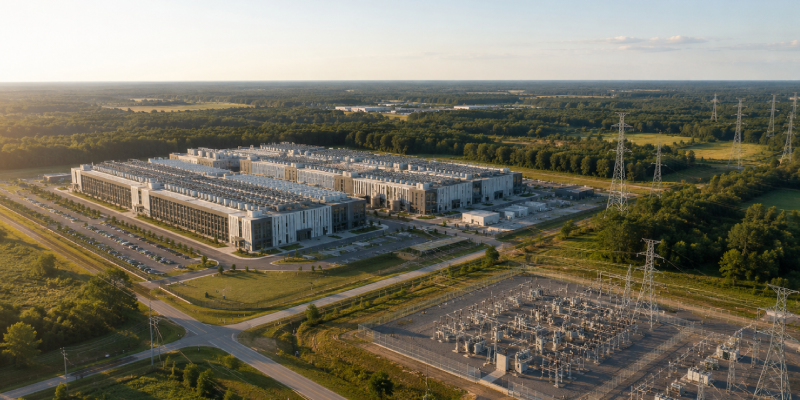
Across the country, artificial intelligence and cloud computing are driving the largest wave of industrial land demand in a generation. Hyperscale operators and their developers are searching for a narrow category of property: large, well-located parcels capable of supporting massive electric loads, redundant connectivity, and heavy infrastructure. If you own rural or semi-rural land — particularly acreage that has sat quietly as farmland, timber, or undeveloped ground — it may be worth far more to the right buyer than you realize.
Axiom AI Group USA, LLC specializes in identifying, evaluating, and advancing land for hyperscale AI and data center campuses of 500 megawatts and above. Before you reach out, here is what we — and the hyperscale buyers we work with — actually look for.
1. Land Size and Configuration
A 500 MW campus typically requires a minimum of 300 to 500 contiguous acres, depending on building footprint, setbacks, substation space, and future phased expansion. Irregular parcels, wetlands, or heavy topography can reduce usable acreage significantly, so gross acreage and usable acreage are not the same number. Larger, squared-off parcels with minimal encumbrances are the most attractive.
2. Electric Power Availability
Power is the single most important factor. Buyers look for proximity to high-voltage transmission infrastructure — generally 115kV or higher — and a realistic path to securing 500 MW or more of deliverable capacity from the local utility or transmission provider. Land near existing substations, or along known transmission corridors, carries a significant advantage, even if full capacity is not yet confirmed or contracted.
3. Fiber Optic Connectivity
Data centers require redundant, low-latency fiber connections. Proximity to existing long-haul fiber routes, or a feasible path for new fiber construction to the site, matters. Land near interstate highways, rail corridors, or existing utility easements often has a shorter path to fiber service.
4. Water Availability
Depending on the cooling technology selected, a campus may need substantial water volumes, or relatively little if closed-loop or air-cooled systems are used. Access to municipal water and wastewater service, or documented groundwater rights sufficient for industrial use, strengthens a site’s profile considerably.
5. Paved Road Access
Construction of a hyperscale campus involves heavy equipment, oversized loads, and sustained truck traffic over several years. Direct frontage on, or short distance to, a paved, load-bearing public road is essential. Sites requiring extensive new road construction face added cost and timeline risk.
6. Natural Gas Availability
Many campuses incorporate on-site backup generation, and increasingly, on-site gas-fired generation to supplement grid power. Proximity to an existing natural gas pipeline, or a feasible tap and lateral connection, adds meaningful flexibility to a site’s power strategy.
7. Floodplain Status
Sites located within a FEMA-designated floodplain face additional engineering, insurance, and permitting requirements, and in some cases are effectively disqualified for mission-critical infrastructure. Knowing your site’s floodplain status in advance — even a rough determination — is valuable information for any prospective buyer.
8. Opportunity Zones and Economic Development Incentives
Property located within a federally designated Opportunity Zone, or within a state or local economic development incentive area, can offer meaningful tax and financing advantages to a developer or buyer. This is a significant point in a site’s favor and worth confirming with your local economic development office.
9. Zoning Designation
Current zoning shapes the entitlement path. Agricultural and unzoned parcels typically require rezoning or a special use permit, while light and heavy industrial zoning can shorten the timeline considerably. None of these designations automatically disqualify a property — but knowing where your land currently stands helps frame realistic expectations from the outset.
YOUR QUICK SELF-ASSESSMENT CHECKLIST
Before contacting us, review the items below. You do not need a confirmed answer for every line — a general sense of your property is enough to start a conversation.
| ☐ | Total contiguous acreage of 300+ acres, with 500+ acres preferred for full campus buildout |
| ☐ | Existing high-voltage transmission (115kV or above) at or near the property line, with substation proximity |
| ☐ | Fiber optic backbone access, or feasible route for new fiber build, within a reasonable distance |
| ☐ | Adequate water supply and rights for cooling systems, or access to municipal/industrial water service |
| ☐ | Direct or near-direct access to a paved, load-bearing road suitable for heavy construction traffic |
| ☐ | Natural gas pipeline access nearby, for backup generation or future on-site power generation |
| ☐ | Confirmation of whether the site sits inside or outside a designated floodplain |
| ☐ | Awareness of whether the property lies within an Opportunity Zone or other economic development incentive area |
| ☐ | Current zoning designation: agricultural, light industrial, heavy industrial, or unzoned |
THINK YOUR PROPERTY MAY QUALIFY?
Every property is different, and many of the factors above are not immediately obvious from a deed or a plat map. Axiom AI Group USA evaluates land confidentially, at no cost or obligation to the landowner, and can often provide a preliminary read on a site’s hyperscale potential after a single conversation.
If you believe your land may be a fit — or simply want an informed second opinion — we invite you to reach out for a confidential, no-obligation telephone conversation.
Toll-Free: (888) 411-8001
Debra Brewster, CEO/CFO: (417) 250-0824 | DJB@AxiomAIUSA.com
William Brewster, COO: (417) 250-0856 | WFB@AxiomAIUSA.com
Website: www.AxiomAIUSA.com
All inquiries and property discussions are held in strict confidence.