Cutting the Cord: Why AI Data Centers Are Building Their Own Power Plants
Faced with years-long interconnection queues, developers are increasingly choosing to generate their own electricity rather than wait for the grid.
By Debra Brewster | Partner / CEO, Axiom AI Group USA, LLC
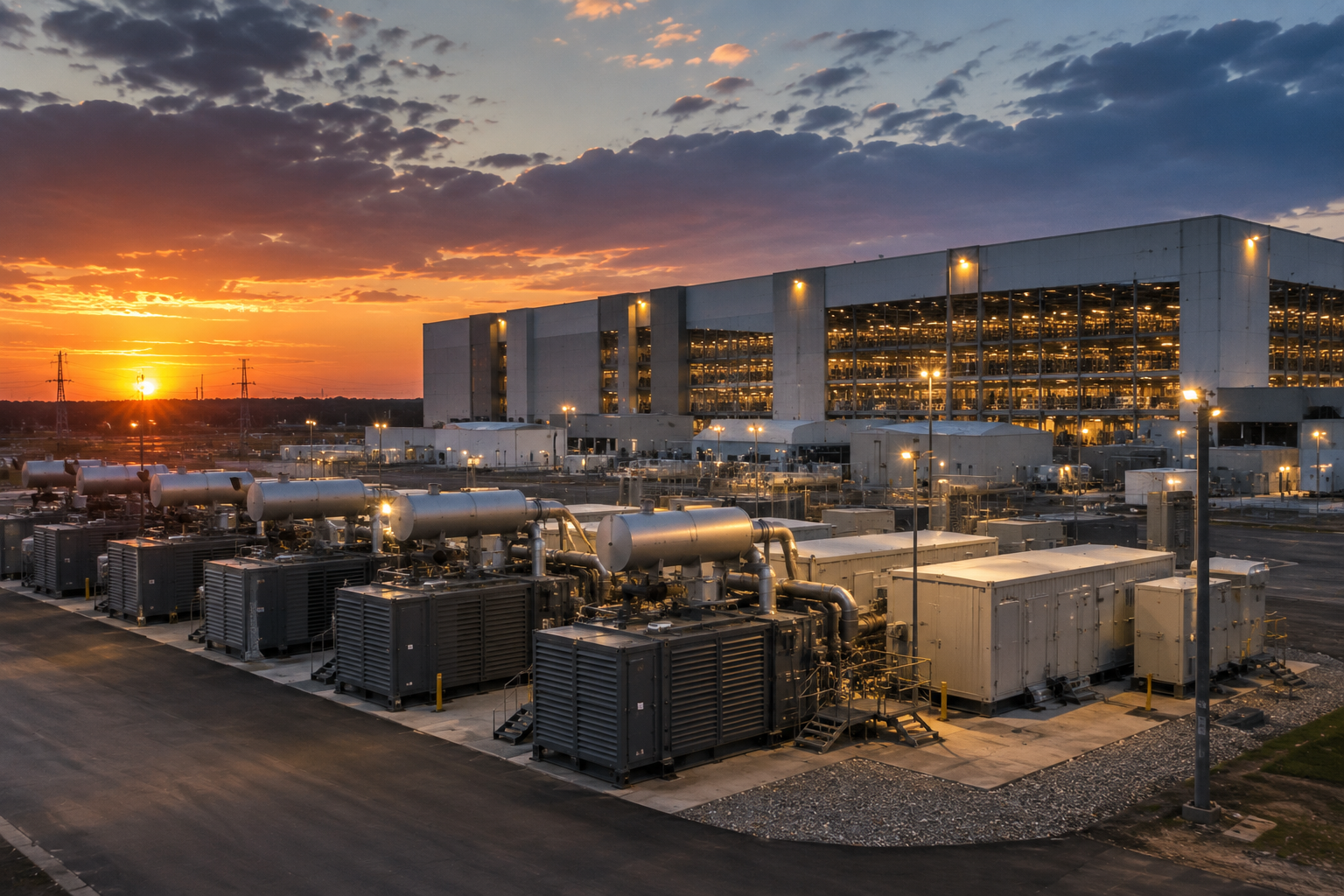
A year ago, a data center generating its own electricity behind the meter, rather than drawing from the public grid, was considered a curiosity, best exemplified by Elon Musk’s xAI trucking mobile gas turbine generators into a Memphis site to build what was briefly the world’s largest data center. Today it is a mainstream development strategy. Roughly one-third of all newly announced US data center capacity now involves at least partial on-site power generation, according to multiple industry trackers, up from effectively zero just two years ago.
The logic is not complicated. Utility interconnection queues in the hottest markets now stretch four to seven years, while a dedicated behind-the-meter gas power plant can often be built in as little as eighteen months. When a hyperscale AI facility can generate ten to twelve million dollars per megawatt in annual revenue, the difference between energizing a campus this year versus five years from now is worth billions of dollars, enough to make developers willing to accept less efficient generation technology and higher fuel costs simply to move faster.
The scale of what is already operating is substantial and growing quickly. xAI’s Colossus facilities outside Memphis account for nearly 1,500 megawatts of operating gas turbine capacity, expanded through dozens of mobile turbines added at a nearby power plant site. Chevron is building a 2.67-gigawatt natural gas plant directly on-site to power a Microsoft AI campus in West Texas, entirely behind the meter. Amazon Web Services took a different approach, acquiring a 960-megawatt data center campus built directly adjacent to Talen Energy’s Susquehanna nuclear plant in Pennsylvania, drawing zero-carbon power before it ever reaches the public transmission grid.
It has not all gone smoothly. One of the marquee Stargate projects backed by OpenAI and Oracle hit a major setback when New Mexico blocked a planned gas pipeline that would have fueled a 2.45-gigawatt on-site power plant. In New Jersey, a Microsoft partner has struggled to obtain an air permit for a 400-megawatt gas plant tied to a $17.4 billion compute deal. Analysts note that permitting friction, not turbine availability, has become the primary constraint on how much behind-the-meter capacity actually reaches commercial operation.
The equipment being deployed reflects genuine scarcity in conventional supply chains. Heavy-duty combined-cycle gas turbines, the most efficient option for continuous baseload power, are largely
unavailable due to long manufacturing lead times, pushing developers toward smaller aeroderivative turbines, reciprocating engines, and solid oxide fuel cells instead. Bloom Energy’s fuel cells have become a particularly prominent choice; the company’s partnership with Brookfield to finance AI infrastructure power projects expanded this year from an initial five billion dollars in committed capital to twenty-five billion.
Legislation is starting to catch up with the trend. A bill introduced in the US Senate this year would formally create a new regulatory category for data centers that build fully independent power infrastructure, disconnected entirely from the main grid. Proponents argue this protects ordinary ratepayers from footing the bill for AI-driven grid upgrades. Critics counter that it risks entrenching a two-tiered energy system, with the largest technology companies opting out of the shared grid entirely while everyone else absorbs the costs of maintaining it. Either way, the direction of travel for the industry is now unmistakable: behind-the-meter power has moved from a workaround to a core strategy, and it is likely to remain one for as long as the public grid cannot deliver electricity on a data center’s timeline.