
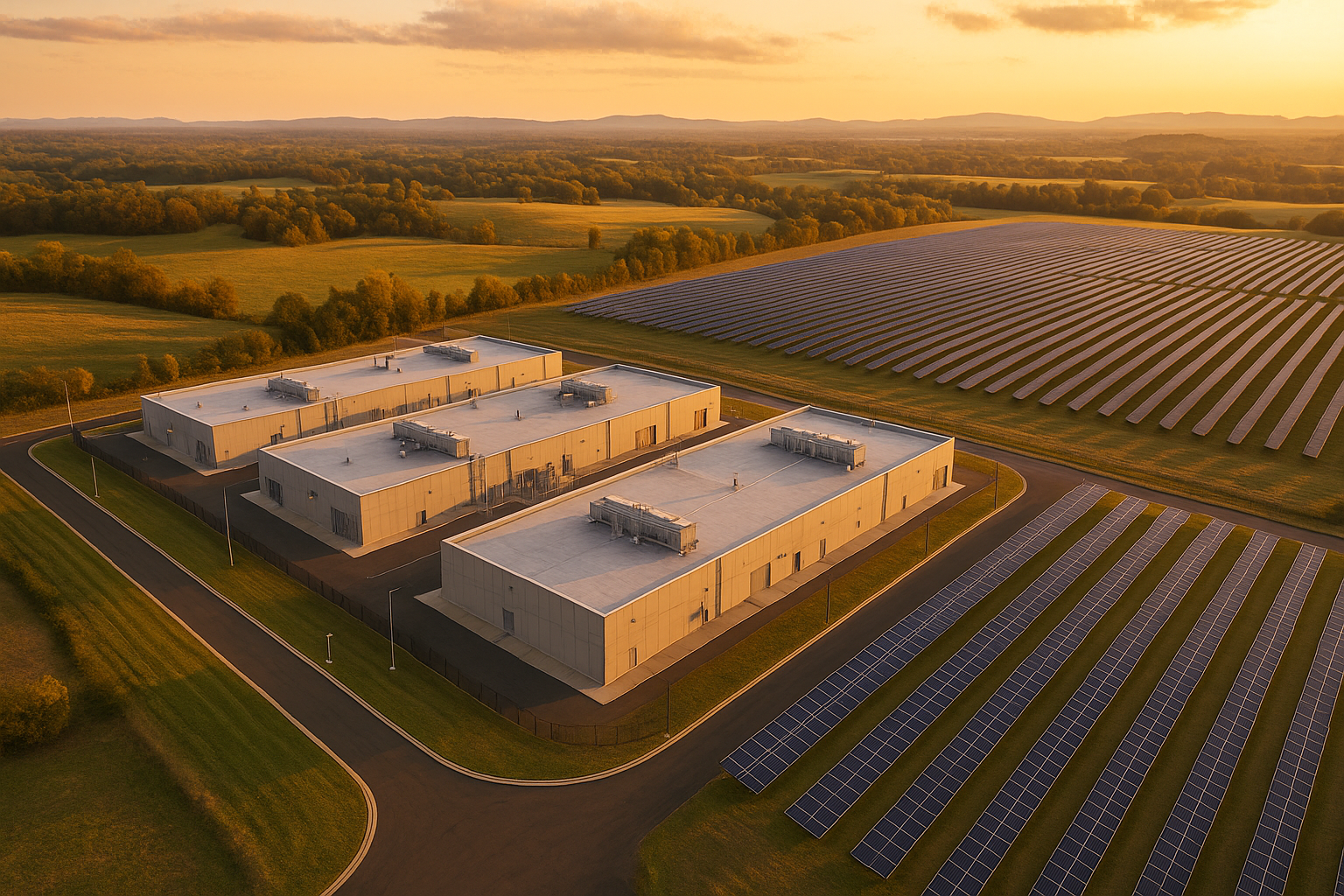
The Case for the Neighbor Nobody Sees: What Data Centers Actually Bring to Their Communities
Beyond the noise of local debates, the tax revenue and infrastructure investment data centers generate are reshaping small communities in measurable ways.
By Debra Brewster | Partner / CEO, Axiom AI Group USA, LLC
Data center development has become one of the most contentious local land-use issues in America, and it is not hard to see why: these are large, industrial facilities that consume significant water and electricity, and residents are right to ask hard questions before welcoming one into their community.
But set against that legitimate scrutiny is a body of real, documented evidence that data centers, done well, can meaningfully transform the finances and infrastructure of the communities that host them.
Consider Mecklenburg County, Virginia, a rural community of roughly 30,800 residents. Tax revenue from a data center complex built there now accounts for about a quarter of the entire county budget, funding a new high school and allowing the county to actually lower its property tax rate. Median household income in the county, once slightly below its neighbor, is now about five percent higher. In Quincy, Washington, home to just 8,600 people, data center tax revenue has helped fund a reuse water system, a new wastewater treatment plant, sidewalks, paved streets, new schools, and a medical center, according to the Washington State Department of Revenue.
The scale of individual corporate commitments has grown substantially. In Ohio, Amazon’s roughly twenty-billion-dollar investment supports an estimated 6,490 full-time-equivalent jobs annually and generated $9.2 million in property taxes and fees in a single recent year. In Louisiana, Meta’s Richland Parish campus is projected to support more than 5,000 skilled trade workers at peak construction, over 500 permanent operational jobs, and more than $300 million in local road, water, and infrastructure improvements. In central Washington, Microsoft’s data centers generated $269 million in regional GDP in a recent fiscal year and paid $26.4 million in property taxes, nearly fifteen percent of the entire property tax base across two counties.
The economic case is not uniform everywhere, and being clear-eyed about that actually strengthens the argument rather than weakening it. Academic research comparing counties before and after a data center opened found that the real economic lift, meaningful employment growth and rising wages, is concentrated in metropolitan areas that already had a base of skilled construction labor, equipment suppliers, and professional services to draw on. In more sparsely populated rural counties, job and wage spillovers were often negligible, which is precisely why the structure of the deal, not just the size of the investment, determines whether a community actually benefits.
That is where community benefit agreements have become the industry’s most important tool for building durable local trust. Lancaster, Pennsylvania negotiated an agreement requiring a data center campus to run on one hundred percent renewable energy, cap daily water use at twenty thousand gallons, and contribute ten million dollars to the city’s sustainability and economic development funds. Henrico County, Virginia used data center revenue to help capitalize a sixty-million-dollar affordable housing trust fund specifically to help teachers and first responders buy homes locally. Google has committed seventeen million dollars to a Water Impact Fund supporting watershed restoration in the regions where it operates.
None of this erases the legitimate concerns communities raise about water consumption, electricity rates, noise, and the pace at which some projects have moved through local approval processes with limited public input. Those concerns deserve serious, transparent answers, not dismissal. But the evidence from communities that have successfully negotiated strong, binding agreements is genuinely compelling: properly structured data center investment can fund schools, lower property taxes, rebuild aging water systems, and create lasting economic opportunity in places that badly need it. The communities getting the best outcomes are, without exception, the ones that treated the negotiation as a genuine partnership rather than either an automatic yes or an automatic no.