
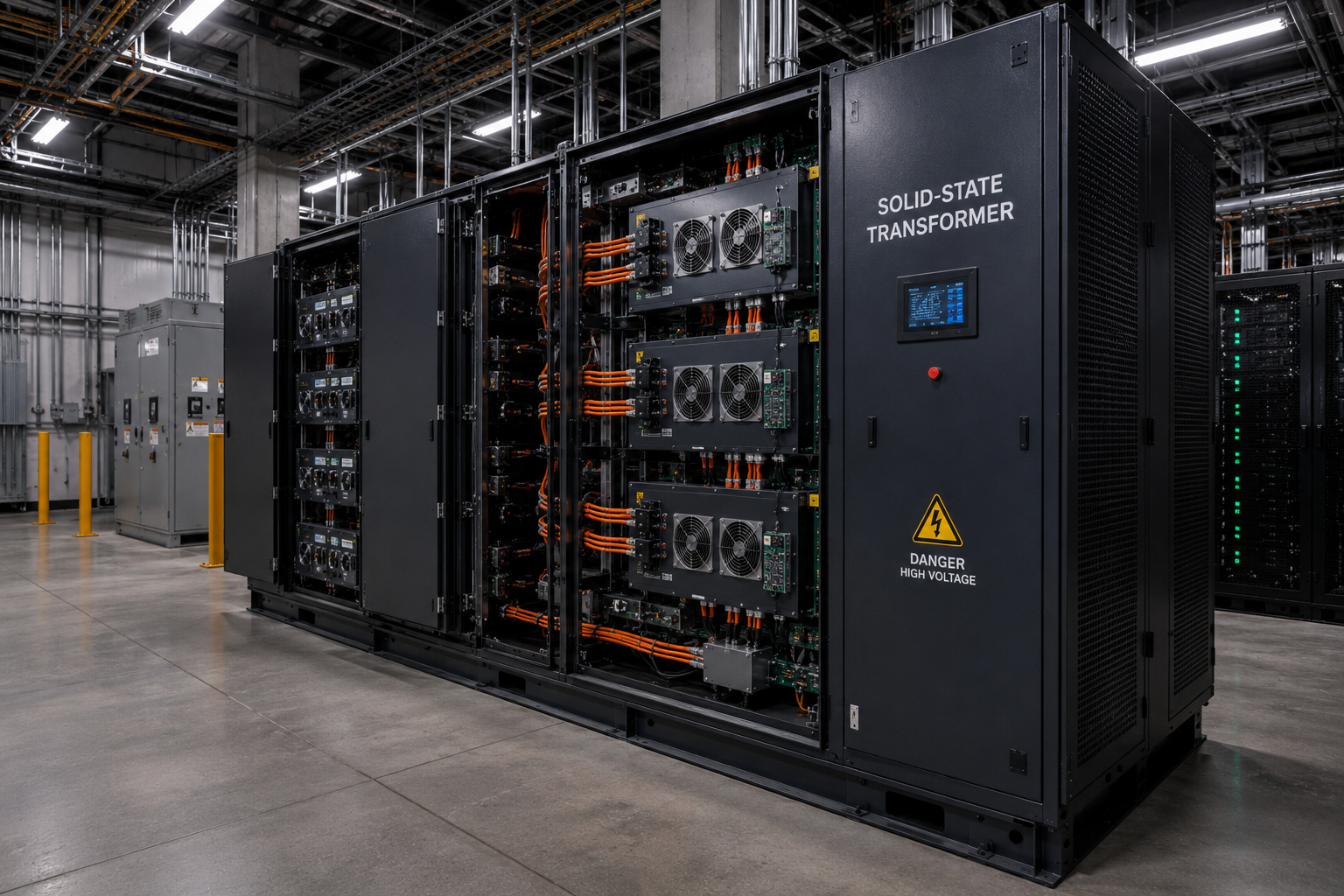
Speed to Power: How Solid-State Transformers Could Shortcut the Data Center Bottleneck
With conventional high-voltage transformers backlogged for years, developers are asking whether solid-state equipment can get campuses online faster.
By Debra Brewster | Partner / CEO, Axiom AI Group USA, LLC
Ask almost any data center developer today what is holding up their next project, and the answer rarely involves computer chips. It involves a transformer. Lead times for conventional high- and medium-voltage transformers have stretched from roughly two years before 2020 to three to five years today, and in some cases quotes are running out as far as 2028. That single bottleneck is now cited as a leading cause behind the delay or cancellation of a substantial share of the data center capacity announced for this year. Solid-state transformers are being pitched, cautiously, as one possible way around it.
The pitch centers on speed and modularity rather than efficiency alone. Where a conventional utility-grade transformer is a custom-engineered, single-purpose piece of equipment requiring years of manufacturing lead time, several solid-state designs are built from modular, hot-swappable power blocks that can, in principle, be manufactured and assembled far faster once production lines are running at scale. A company called DG Matrix has built its Interport platform explicitly around this modularity, and it has already been selected by renewable energy firm Exowatt for projects aimed at eliminating traditional interconnection bottlenecks entirely.
The economics of speed matter enormously in this industry right now. A single hyperscale AI facility can generate somewhere between ten and twelve million dollars per megawatt in annual revenue, meaning a developer who can bring a hundred-megawatt campus online even a year or two early is looking at a windfall measured in the hundreds of millions of dollars. That math is why hyperscalers have shown a willingness to pay a premium for anything that shortens the path to energization, whether that is behind-the-meter gas turbines, fuel cells, or, increasingly, next-generation power electronics.
It is important to be candid about where the technology actually stands today. Most solid-state transformer products remain in pilot deployment or early commercial stages rather than mature, field-proven equipment with decades of duty-cycle history. Vendor roadmaps for the highest-profile products, including offerings from Enphase and SolarEdge, generally point to customer pilots in 2027 and volume shipments in 2028, which is to say the technology is arriving on a timeline that runs parallel to, rather than ahead of, the current wave of gigawatt-scale campus construction.
That has not stopped serious capital from moving into the space. Venture investors have poured more than a quarter-billion dollars into solid-state transformer startups within the past year alone, and established grid equipment manufacturers including ABB, Siemens, and Mitsubishi Heavy Industries are all fielding competing programs. Analysts tracking the sector for US data centers alone project the addressable market to roughly quadruple by the end of the decade, growing at better than 30 percent annually as silicon carbide components mature and production scales.
For a developer evaluating financing structures and construction timelines today, the prudent position is to treat solid-state transformers as a credible bridge technology worth tracking closely and specifying into future-phase designs, rather than as a guaranteed solution to secure this year’s interconnection timeline. The underlying protection and semiconductor layer, contactors, fuses, and silicon carbide modules, is genuinely mature from years of qualification in electric vehicle and industrial applications. What remains unproven at scale is the full, certified transformer built around it, operating continuously for years at a live hyperscale campus. That proof point is likely still a construction cycle or two away.