
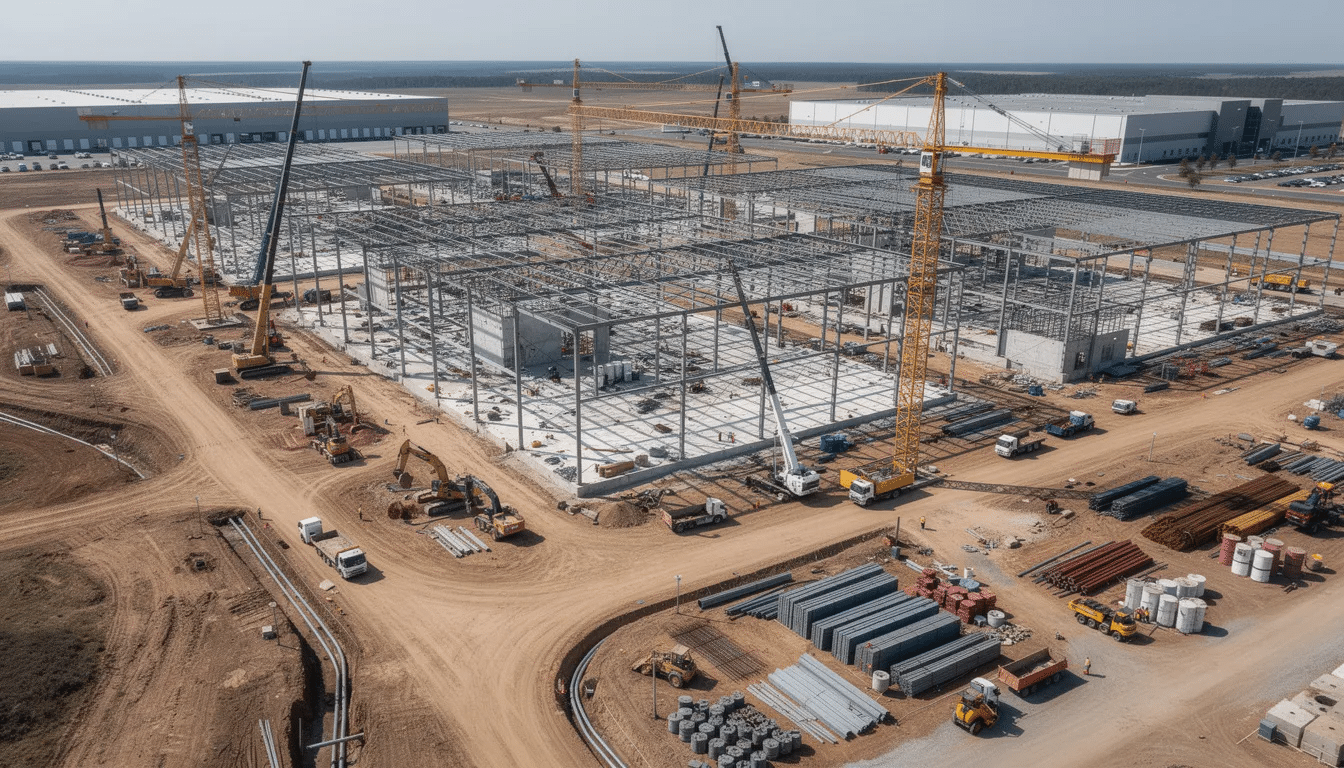
Gridlock on Every Front: The Supply Chain Backups Slowing the Data Center Boom
Permitting, power equipment, and skilled labor are all backlogged at once, and no single fix resolves all three.
By Debra Brewster | Partner / CEO, Axiom AI Group USA, LLC
Every major bottleneck constraining data center development right now shares one common trait: none of them can be solved simply by writing a bigger check. Capital is not scarce in this industry. Hyperscalers collectively committed more than $650 billion to data center expansion this year alone. What is scarce is the physical equipment, the skilled labor, and the regulatory bandwidth needed to actually deploy that capital on the ground, and all three constraints are hitting simultaneously.
Start with the equipment itself. Lead times for high-voltage power transformers have stretched from roughly two years before 2020 to a range of three to five years today, with some high-capacity units quoted as far out as 2028. Medium-voltage switchgear is described by multiple industry analysts as effectively sold out through 2028. The root causes are structural rather than temporary: constrained global supplies of grain-oriented electrical steel, a limited number of qualified production slots at the handful of manufacturers capable of building this equipment, and a genuine shortage of the specialized welding, winding, and testing expertise required, none of which scales quickly regardless of capital investment.
Layered directly on top of the equipment shortage is the interconnection queue itself, which has become its own distinct bottleneck. As of the end of last year, more than 2,600 gigawatts of generation and storage sat in US interconnection queues nationally, more than double the country’s entire existing operating capacity, with average wait times now approaching five years and, in the most constrained data center markets, stretching to seven. Roughly 80 percent of projects entering these queues in the current environment ultimately withdraw, largely due to unpredictable multi-year delays and grid upgrade costs that can consume 30 to 37 percent of a project’s total budget.
The labor shortage compounds both problems at once. The US Bureau of Labor Statistics projects that roughly 340,000 of the 650,000 data center construction and operations positions needed this year will go unfilled without significant intervention. The country needs an estimated 300,000 additional electricians to meet current demand, against a trade that loses only about 20,000 workers to retirement annually. The competition for that limited pool has pushed specialized electrician wages in markets like Northern Virginia and Texas above $280,000 a year, driven construction unemployment to a record low of 3.2 percent, and stretched contractor project backlogs to eight to twelve months before new work can even begin.
Permitting adds a fourth, distinctly human layer of friction on top of the physical and labor constraints. More than seventy data center projects were rejected or restricted by local governments in just the first four months of this year, more than in all of last year combined, and one poll found 71 percent of Americans would oppose a data center being built near their home. Community opposition tied to water use, noise, and rushed approval timelines is now a directly measurable cause of project cancellation, not merely a background risk.
There is no single fix on the horizon for a problem with this many independent moving parts. Manufacturers including Schneider Electric are investing hundreds of millions of dollars to expand domestic transformer and switchgear production, some developers are manufacturing their own equipment to bypass traditional supply chains entirely, and federal agencies have taken steps to accelerate transmission permitting. But steel takes time to source, welders take years to train, and interconnection studies take however long the queue in front of them takes. The projects that navigate this environment successfully over the next several years will be the ones that started solving for equipment, labor, and permitting years before breaking ground, not the ones assuming any single piece of the puzzle would resolve itself once construction began.